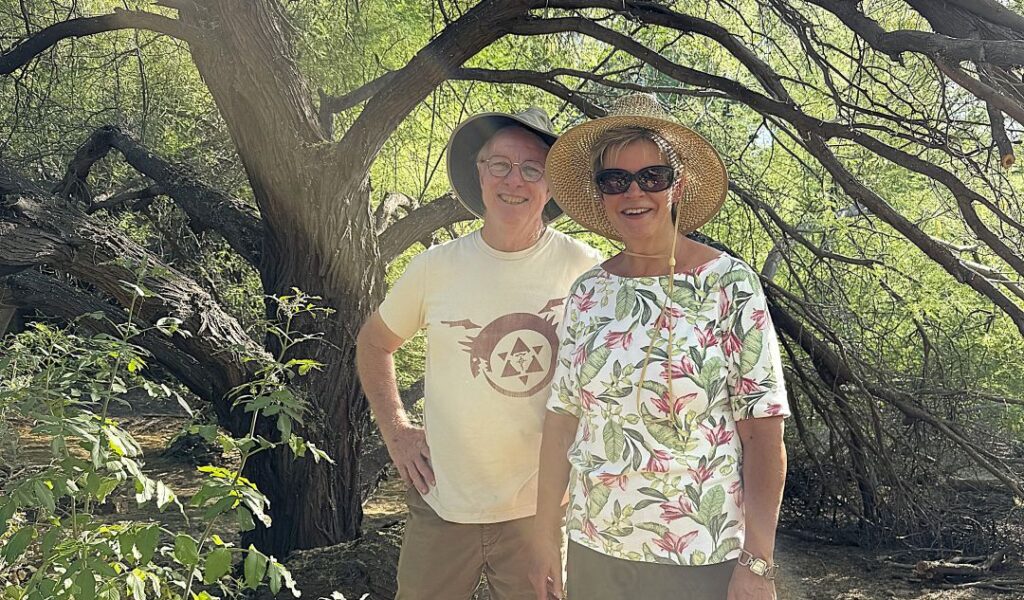
Matthew Chew and Kelly Duffin
by Kelly Duffin
Matthew Chew is an ecologist and a leading voice in rethinking “invasion biology,” which has cast “native” species as good and “non-native” species as bad and has been a prevailing paradigm in conservation for decades. That paradigm is often used to justify cruel and sometimes lethal actions against non-native or introduced species such as Mute Swans. He has published widely on the subject, including in academic journals and was a co-author of the influential Nature article, “Don’t Judge Species on their Origins.”
Over the years, I’ve had a few opportunities to connect with Dr. Chew, though always from a distance since he is at Arizona State University. But on a recent trip, I had the pleasure of visiting him and his wife, botanist Juliet Stromberg, at their home in Phoenix.
During the visit we talked about the human activity that has reduced, altered, and destroyed so much of the habitat that was once hospitable to species considered native; the impacts of climate change and the range shifts that inevitably result; the futility of imposing geographic boundaries of nativeness on plants and animals who are mobile; the beneficial roles that introduced species can play; the line between species adaptation and evolution; and the inherent dynamism of ecosystems.
It was an illuminating afternoon, the more so because the conversation happened as we were walking in their remarkable garden/forest. Nearly 30 years ago, they purchased the land as an abandoned citrus farm. Since then, they have transformed it – or allowed it to transform itself – into a kind of wild paradise.
The property spans four acres. Narrow paths wind through bushes, trees, succulents, flowers, and undergrowth. Canopies rise overhead and provide shade. Some trees have long, flowing branches, including one they call “the Octopus.” Plants at every stage of life are present, from new growth to mature specimens and ones who, having bloomed once, are now dying.
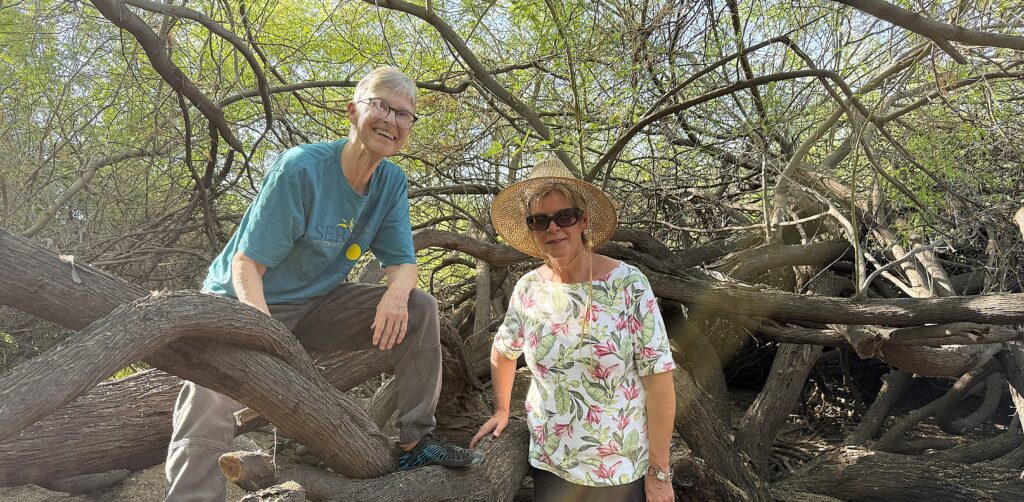
Juliet Stromberg in the Octopus tree, with Kelly Duffin
The space also attracts a wide range of animals, from bees and butterflies to birds, rabbits, and coyotes. Recently the species count on the property surpassed 900 with the appearance of a beetle.
Dr. Stromberg kindly gave me a copy of her most recent book, The Unruly Wild: Embracing Ecological Change in the Southwest. The book blends her encyclopedic botanical knowledge with personal reflection. Among other things, it traces her journey from removing non-native plants to embracing ecological change and diversity. Along the way, she highlights fascinating characteristics of both iconic and lesser-known plant species in their region, including long-timers and recent arrivals.
Dr. Chew and Dr. Stromberg have made important contributions to their fields. It was an honour and a joy to be in their company.