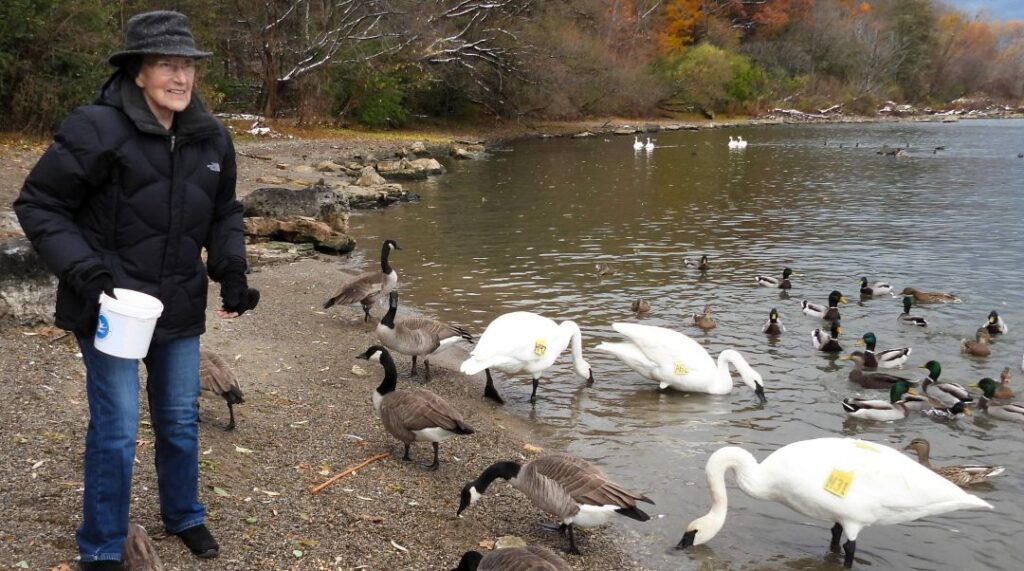
Bev Kingdon with Trumpeter Swans at LaSalle Park in Burlington, Ontario
by Kelly Duffin
Bev Kingdon is a hero in swan circles, though she would never describe herself that way. A key leader in the restoration of Trumpeter Swans in Ontario, Bev worked tirelessly for decades to bring the species back from near-extinction caused by overhunting. Her dedication is an inspiration to me. And, like me, Bev is a lover of all swans – Trumpeters, Mutes, and Tundras. “A swan is a swan,” is one of her mottos, and it always warms my heart to hear her say it.
Bev coined the term “swanitis” – a condition she says is contagious and has no cure. She contracted it at the age of nine. Her family was standing on a bridge in a park in Bracebridge when Bev spotted a beautiful pair of Mute Swans swimming down the creek. When it was time to leave, she threw her first-ever temper tantrum, clinging to the bridge railing and refusing to go. When she finally had to leave she vowed that one day she would “have a backyard full of those things.”
And she did!
On her parents’ property in northern Ontario, Bev had a pond dug for Mute Swans. Then, in the late 1980s, Ontario’s Trumpeter Swan restoration project began with the vision and leadership of Harry Lumsden. It was then that Bev had a second pond dug for Trumpeters. With Harry Lumsden’s guidance, Bev and her late husband, Ray joined the few early “cooperators” who cared for captive Trumpeter parents and their cygnets before the young swans were released into the wild. Just four years after Bev joined the effort, the first pair of wild Trumpeter Swans migrated to Lake Ontario to spend the winter. They landed less than a mile from Bev’s home in Burlington.
Bev developed a special relationship with the female (pen) of that pair, named Pig Pen, so you can imagine her concern when, one day, she couldn’t find the swan anywhere. Bev searched and searched before finally calling Wye Marsh, where Pig Pen had hatched to captive parents. Sure enough, a few days later, Pig Pen and her mate arrived at the marsh for the breeding season. She had mastered migration without having migrating parents – and she was safe.
The Burlington area, and LaSalle Park in particular, soon became important wintering grounds for many more Trumpeter Swans. The birds typically nest in central and northern Ontario, then fly south in winter in search of open water. Bev and Ray began caring for swans at both their northern property and at LaSalle. When Bev was in Burlington, she was at LaSalle every day, usually all day.
When she wasn’t at LaSalle she was helping to build the volunteer networks, partnerships, and support systems that enabled the swans to thrive, while also creating opportunities to track and learn from their movements, behaviour, family histories, injuries and causes of mortality.
Over the years, Bev accumulated countless stories: perilous adventures tending to the birds, exhilarating successes, and heartbreaking setbacks and losses.
She still feels a pang when the swans leave LaSalle each spring. And she felt something similar when the restoration program officially came to an end. In 2008, biologists declared that the Trumpeter Swan population had become self-sustaining. “I had a very strange reaction,” she says. “I did not jump for joy.”
Perhaps she worried that something might still go wrong. Or perhaps it was what athletes feel, she has since been told, at the end of a season after they win the trophy and it’s all over.
The success is remarkable. From just 69 Trumpeter Swans remaining in Canada in the 1930s, the population had grown to an estimated 45,000 by 2021.
Bev played an integral role in that extraordinary achievement and has received dozens of awards for her work – just look at the photo below of a few of them!
How fortunate it is that Bev caught swanitis!
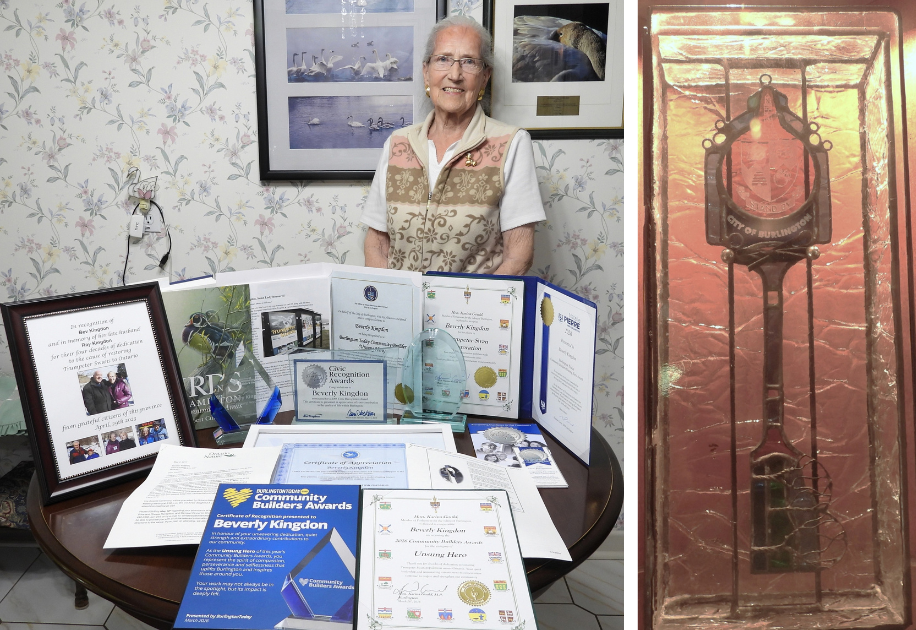
Bev with a few of her awards and (right) her Key to the City, awarded by the City of Burlington